

The Village Is the Work: Reflections From SAITH’s LIC Screening of No Country for Mothers
Thursday night’s screening and conversation became a deeply moving experience. The room was full of honesty, reflection, community, and momentum as we watched No Country for Mothers and witnessed the documentary’s subjects share their experiences of American motherhood. On screen, we journeyed alongside Executive Producer Reshma Saujani and her Moms First team as they architected better support for mothers, children, caregivers, and families across this country.
We came together to witness an investigation and left with a call to action. The testimonials of Reshma, Hillary Clinton, Ilana Glazer, Genevieve, Nadia, Adriana, and Rachel named what so many mothers, caregivers, educators, and families already know: motherhood is not only personal, it is structural, economic, cultural, political, and deeply communal.
The setting mattered, too. Stuart Cinema & Cafe welcomed us into a private screening room that felt lush, intimate, and perfectly suited for the conversation that followed. From the ambiance of the theatre to the flavorful sips & bites, the experience felt intentional from the moment we walked in. As a Black-Latina-mom owned theatre, Stuart Cinema & Cafe also reflected the kind of community-centered space this work deserves.
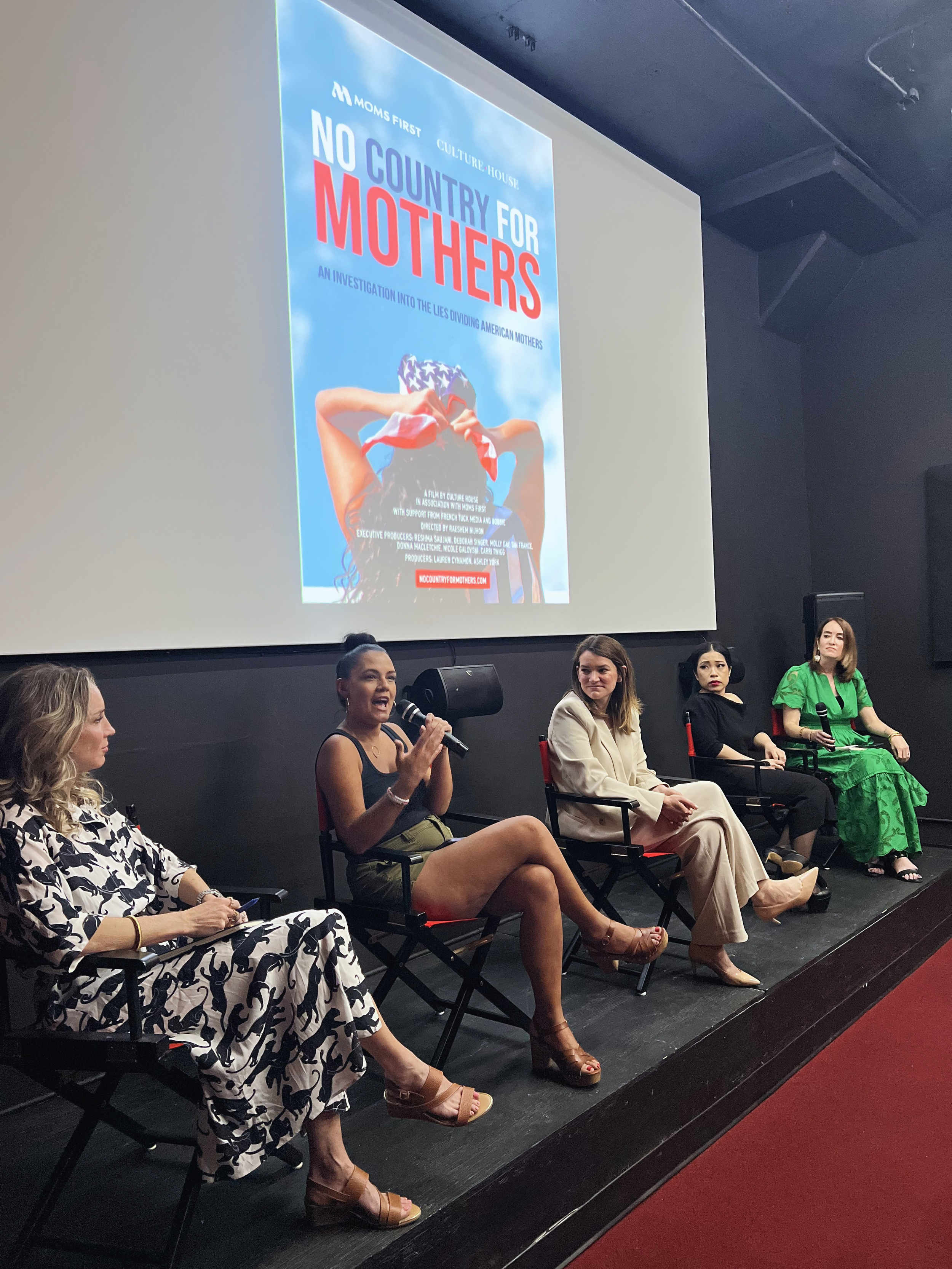

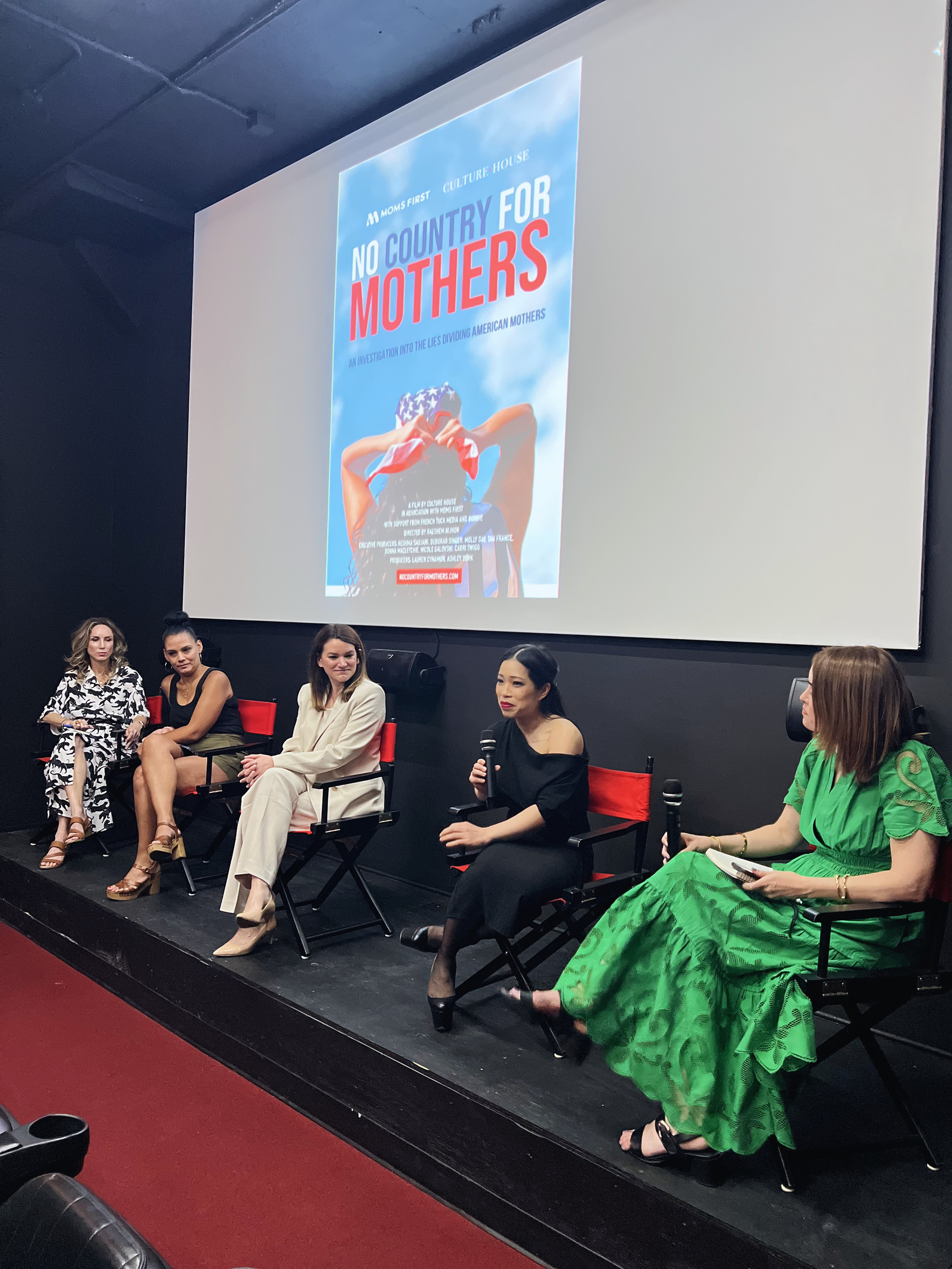
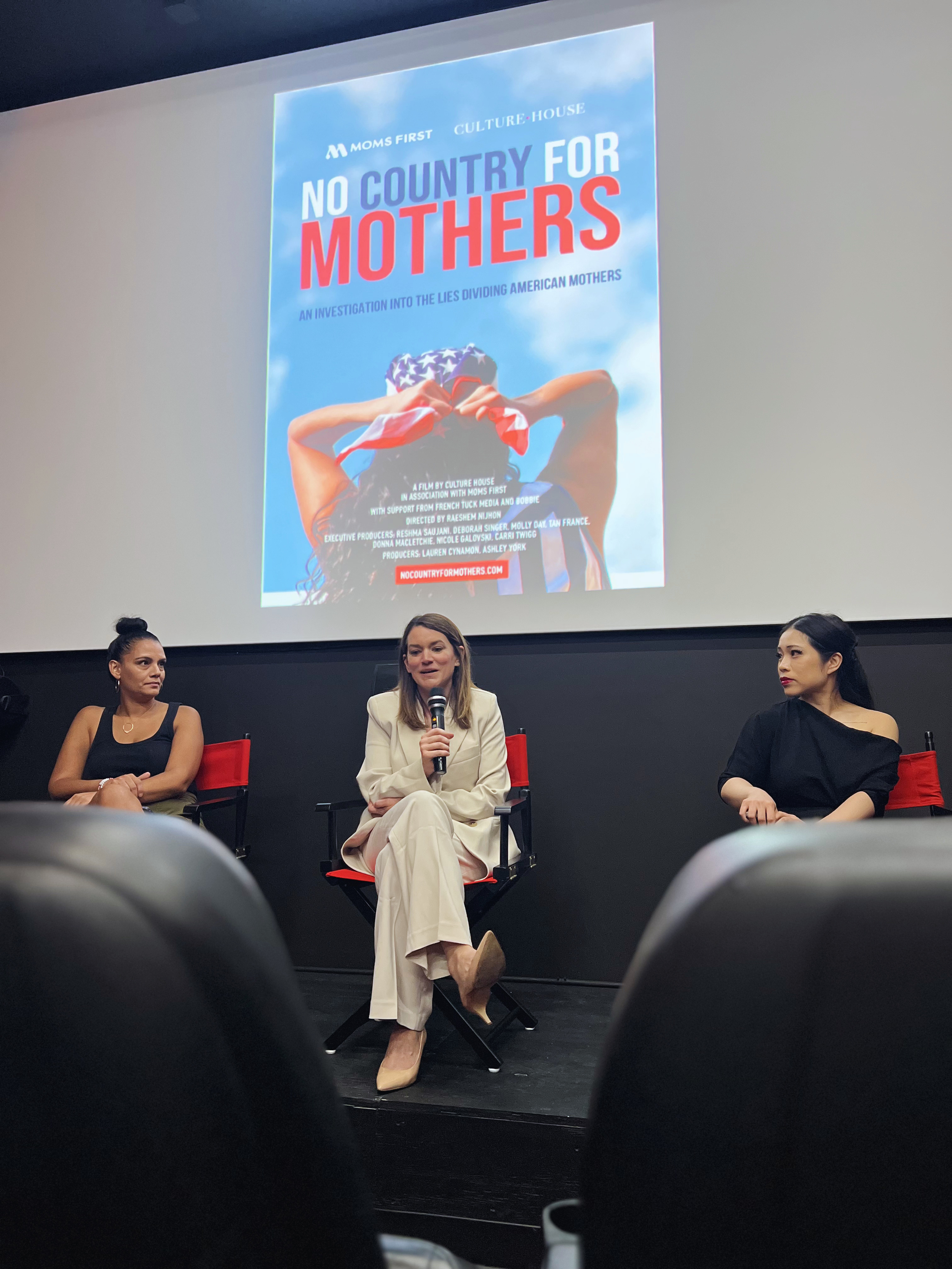
We Learned That the Village Is the Work
Our post-screening panelists transformed the evening into a conversation about what mothers carry, what families need, and what it would take to build a culture that truly supports caregiving.
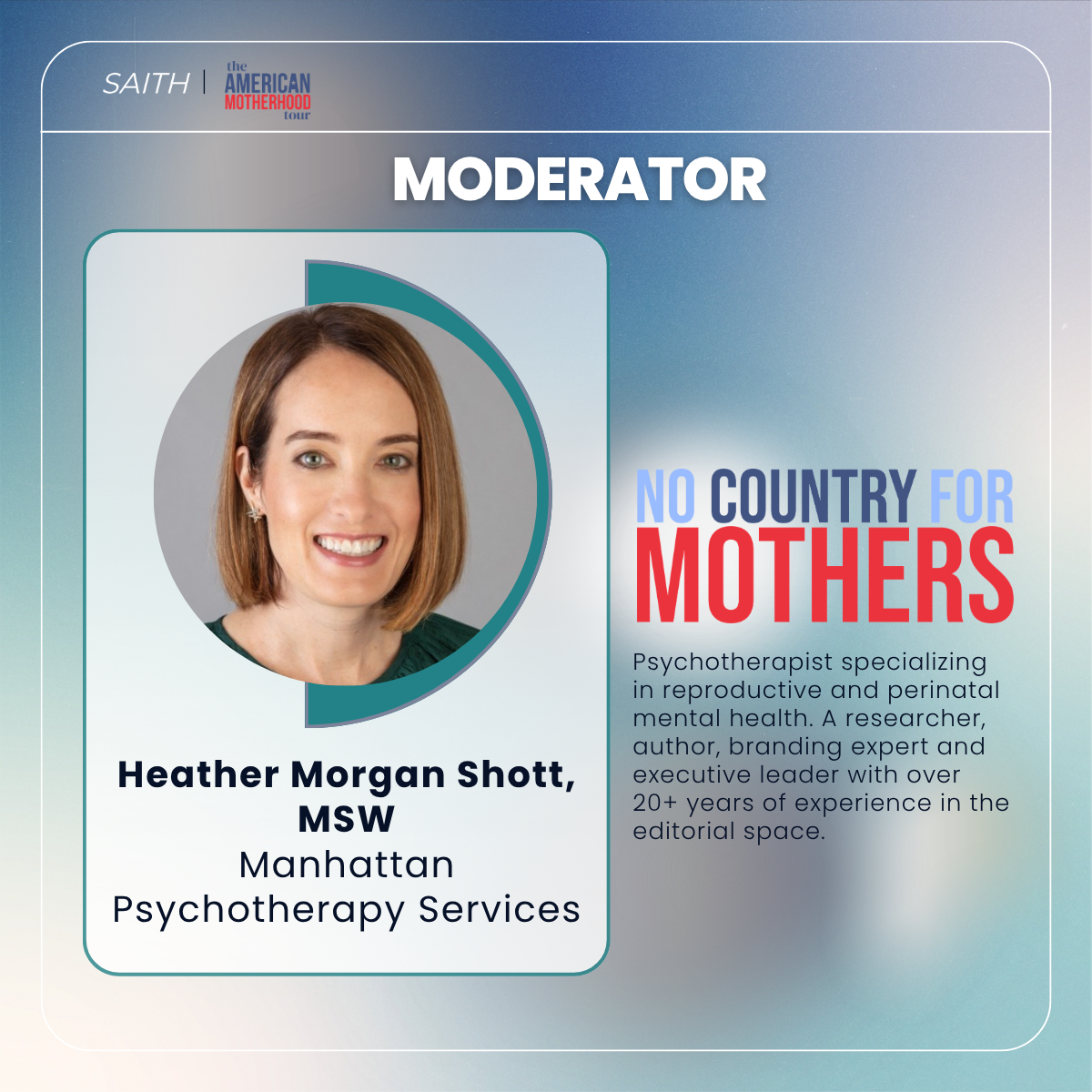
Heather Morgan Shott asked one of the evening’s most resonant questions: what would it take for every mother to have access to some form of village? Guiding the conversation with care and clarity, she shared that it took more than a decade to build hers. Heather invited us to think about what it would take to rebuild support for mothers in the United States while learning from places that never fully abandoned care, community, and shared infrastructure in favor of individual resilience.
Danielle McLaughlin offered a global perspective, sharing how New Zealand protects a new mother’s job for one year after maternity leave and how its culture and policies make part-time work more viable for working mothers. Her comments challenged us to imagine what it would look like if care, work, and family were designed to coexist. She also pushed us to confront public and private accountability more directly. If government budgets reveal what we value, and corporations claim to care about families, then the commitment must show up in funds allocated, business models, and parent-integrated practices.
Yessy Malave grounded the conversation in one of the most personal and urgent realities of care: trust. As a Puerto Rican mother of three, she shared her cultural experience of multigenerational care and how difficult it has been to find that same built-in support in the contiguous U.S. She reminded us that where we send our children matters deeply. Quality, safety, and confidence in childcare are foundational to whether families can work, rest, and move through the world with any sense of security. Yessy emphasized that educators must be prioritized and compensated for the essential work they do to make those trusted environments possible.
Stephanie Mulhern Ogorzalek championed embedding equity directly into policy. She reminded us that the United States continues to stand apart in its lack of paid leave, even as mothers, especially Black mothers, face devastating health and mortality disparities. Drawing from her work at the intersection of gender, health, and policy, Stephanie urged us to see maternal care as more than a healthcare issue. It is also a question of access, infrastructure, racial equity, and political will. Her comments positioned paid leave, maternal health, and family support systems as public responsibilities, and reinforced the urgency of designing them with equity built in from the start.
Dr. Cecilia Dones offered a powerful reminder that rebuilding the village must begin at the human level. When asked about the growing use of AI in parenting, childcare, and community-building, Dr. Cecilia brought the conversation back to the irreplaceable role of human connection and vulnerability. She encouraged us to start with individual mothers, to speak honestly, extend ourselves to one another, and build community through real acts of support. Her comments reminded us that while systems must change, we have the ability to practice care now: one mother, one conversation, and one act of support at a time.
Across the evening, we also heard expert perspectives on universal childcare, compensation for care choices, bipartisan collaboration, the role of fathers and male partners, and the economic realities facing caregivers.
Danielle’s reminder that “how we spend our money shows what we value,” Heather’s guidance on matrescence, Yessy’s emphasis on trust, Stephanie’s policy precision, and Dr. Cecilia’s reminder to hold on to our humanity enriched us with the knowledge that meaningful change will require both community-level action and institutional accountability.
This movement must be grassroots, but it cannot stop there. It must be “grassroots plus plus”: rooted in community, strengthened by policy, funded through budgets, supported by workplaces, and carried into the systems that shape how families live. This is beginning to sound a lot like the village we’ve been looking for.
We want this conversation to travel beyond Thursday evening and into homes, workplaces, schools, think tanks, and onto the desks of decision-makers. Visibility is key because the realities of American motherhood must be seen more clearly and supported more intentionally. For mothers to have true choice, individuals, communities, and institutions must understand the systemic failures that keep mothers away from home when they would rather stay, out of the workforce when they would rather work, and without the support to make sustainable choices across that full spectrum.
We want to keep asking: where are the systems that acknowledge the essential role of motherhood with funding, governance, and care?
We will keep asking as SAITH hosts another screening in August. This will be a virtual watch party for No Country for Mothers via Mobilize. Details will be available on the Free to Gather Fund page and on our social platforms for @saithcodotcom.
Your Chance to Carry the Conversation Forward
Moms First invites communities to host their own watch parties and continue the conversation sparked by No Country for Mothers.
The work doesn’t end with one screening. Gather neighbors, people with opposing viewpoints, educators, caregivers, like-minded friends, fathers, ERGs, office colleagues, and family. Host a screening in a living room, lounge, conference room, community space, or anywhere this message can be felt and where the conversation can spark collective action.
Continue the Work With SAITH
SAITH helps organizations turn complex information into focused strategy, stronger performance, and measurable growth. Through business intelligence, data strategy, strategic advisory, and decision support, we help leaders make clearer, more confident decisions.
This work is connected to the same belief that shaped the evening of June 25; when people have better information, stronger systems, and more intentional support, they can make better choices and build more sustainable futures.
To stay connected to future gatherings, insights, and opportunities to work with us directly, send us a quick note below.
Thank you for gathering with us. This was not just a screening. It was a beginning.